
Justices’ Licences
There are 4 types of Justices’ Licence:
On-Licence
An on-licence is defined in the Licensing Ordinance 1994 (“the Ordinance”) as authorising the sale for consumption either on or off the premises for which the licence is granted. This type of licence would be considered appropriate for a ‘pub’ or ‘bar’ type business.
Off-Licence
The Ordinance defines an off-licence as authorising the sale for consumption off the premises. This type of licence would be considered most appropriate for a ‘shop’ type business, or a wholesaler.
Part V
There are 3 types of Part V licence:
- Restaurant only
- Residential only
- Restaurant and Residential
A Part V licence authorises the sale of intoxicating liquor to a bone fide guest and/or as ancillary to a main meal. These types of licence would be most appropriate for a restaurant, bed and breakfast or hotel type business.
Occasional Licence
An Occasional Licence gives a person permission to sell intoxicating liqour at a specific event in premises which would not ordinarily be licensed.
An application for an Occasional Licence can be made by filing an application with the court with any applicable fee. Once received, the Clerk to the Summary Court will notify the Chief Police Officer of your application and advertise it on the Court List. If no objections to your application are received by a specified date (usualy 7 days after your application is filed) the Clerk to the Summary Court may deal with your application administratively (without a hearing). If any objections are received, the Clerk to the Summary Court will notify you of the substance of the objection and the time and date for the hearing of your application before the Licensing Justices.
How to apply
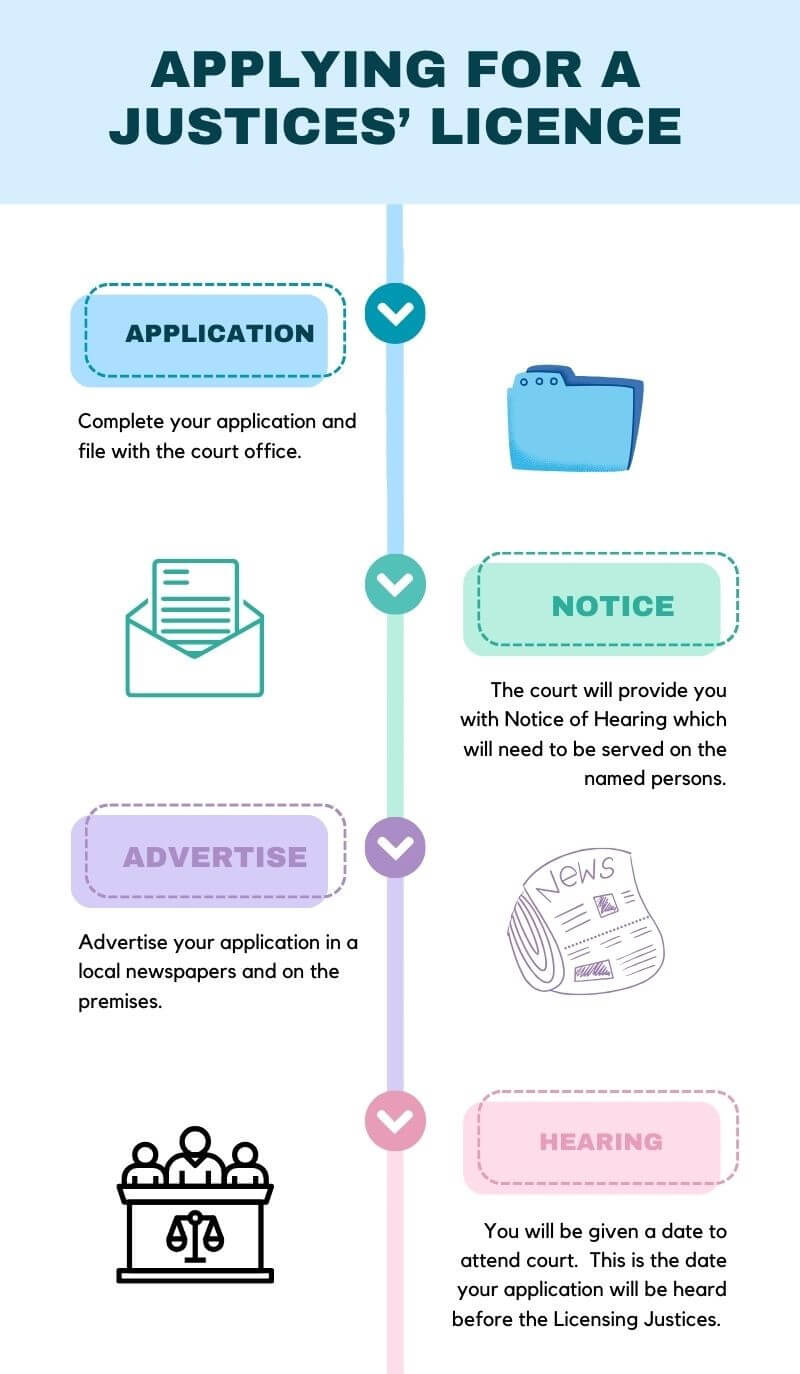
To apply for a Justices’ On-Licence, Off-Licence or Part V you will need to complete the relevant application form and file it with the court with any application fee. Once the application is filed, you will be given a hearing date for your application. You will also be required to notify the Chief Police Officer, Chief Fire Officer and Chief Executive of your application and hearing date. In addition, you will need to advertise your application on the premises and in a newspaper circulating the Falkland Islands. At your hearing, you will need to show the court proof that you have met these requirements. At your hearing, you will need to give evidence on oath. The Licensing Justices will then make a decision.
More Licenses
Extensions of Permitted Hours
For premises with a Justices’ On-Licence, it is possible to apply to extend your permitted hours for sale of intoxicating liquor. The Ordinance states that this may only be done for a special occasion.
The Ordinance provides some guidance about what a ‘special occasion’ may be. It states that a special occasion is one which
- creates a potential demand for liqour by those participating in it; and
- does not regularly occur or recur throughout the year; and
- is a function which may be classed as a special occasion but recurs so often it ceases to be a special occasion.
Examples of a special occasion given are Christmas Eve or New Year’s Eve. It also states that a weekly darts match would not be a special occasion.
Applications may be submitted to the court office. Any application received will be sent to the Chief Police Officer for any comment and advertised on the court list for 7 days. If no objections are received, the Clerk to the Summary Court will deal with your application. If any objections are received, your application will be listed for hearing before the Licensing Justices.
Under 18s are permitted into a premises which has a Justices’ Off-Licence or a Part V Licence.
To be permitted into a premises with a Justices On-Licence, there must be a valid children’s certificate in place.
To be permitted into a premises with a Club Registration Certificate in place, there must be a Camp Exemption Order or statutory exemption.
There are a number of activities which are prohibited in licensed premises and each licence holder should make themselves aware of what they are. They can be found in the Licensing Ordinance 1994.
Prohibitied activities include:
- Betting (unless for moderate stakes on games of pure skill)
- Sale by auction
In the second week of May of each year the Licensing Justices’ are required by law to sit and consider the renewal of licences.
On-Licences, Off-Licences & Part V Licences will be placed for automatic renewal unless the licence holder informs the Clerk to the Summary Court that they no longer require the licence. If an objection to a licence is received, the licence holder will be informed and a full hearing will take place.
Club Registration Certificates and Camp Exemption Orders must be applied for each year. You will be sent a letter and application form each year if this applies to you.
The permitted hours for licensed premises can be found in sections 42 and 43 of the Licensing Ordinance 1994. The court has copied the two sections below to assist but does not guarantee its accuracy. For up to date information please visit www.legislation.gov.fk
42 Permitted hours in licensed premises
- Subject to the following provisions of this Ordinance, the permitted hours in licensed premises are-
- on weekdays, except Fridays and Saturdays, the hours from 10 a.m. to 11 p.m.;
- on Fridays and Saturdays, except Christmas Day and Good Friday, the hours 10 a.m. to 11.30 p.m.;
- on Sundays and Good Friday, twelve noon to half past ten in the evening; and Good Friday, twelve noon to half past ten in the evening;
- on Christmas Day, twelve noon to half past ten in the evening;
- on any day, the hours which-
- are hours during which passengers of a cruise ship are paying a visit to Stanley;
- fall between the hours of 10 a.m. and 11.30 p.m.; and
- are not hours during which the sale of intoxicating liquor would be permitted by virtue of any of the paragraphs (a) to (c) of this subsection.
In paragraphs (a) to (d) of this subsection “weekday” means every day of the week except Sundays and any day of the week on which Good Friday or Christmas Day falls.
- The permitted hours set forth in subsection (1) may be amended by order made by the Governor under this subsection amending the said subsection (1).
- In premises licensed only for the sale of intoxicating liquor for consumption off the premises the permitted hours on weekdays and Sundays, other than Christmas Day and Good Friday, shall begin at 8 a.m. but otherwise be the same as those specified in subsection (1)(a).
- The permitted hours under a Part V licence shall end on the evening of every day one half of an hour later than those applying under this section in respect of premises for which a justices’ on-licence is held.
- In this Ordinance-
- “the general licensing hours” means the hours specified in sub-section (1)(a) to (c); and
- references to “the permitted hours” shall, except in so far as the context otherwise requires, be construed in relation to any licensed premises as meaning the hours between which, by virtue of this Ordinance and any conditions attached to any justices’ licence applying to those premises, intoxicating liquor can lawfully be sold or supplied in those premises.
43 Drinking-up time and other exceptions
- Where intoxicating liquor is supplied in any premises during the permitted hours, section 42 does not prohibit or restrict-
- during the first twenty minutes after the end of any period forming part of those hours, the consumption of the liquor on the premises, nor, unless the liquor was supplied or is taken away in an open vessel, the taking of the liquor from the premises; or
- during the first half hour after the end of such a period, the consumption of the liquor on the premises by persons taking meals there, if the liquor was supplied as an ancillary to their meals.
- Section 42 does not prohibit or restrict-
- the sale or supply to, or consumption by, any person of intoxicating liquor in any premises in which he is residing;
- the ordering of intoxicating liquor to be consumed off the premises, or the despatch by the vendor of liquor so ordered;
- the sale of intoxicating liquor to a trader for the purposes of his trade, or to a registered club for the purposes of the club; or
- the sale or supply of intoxicating liquor to any canteen or mess.
- Section 42 does not prohibit or restrict as regards licensed premises-
- the taking of intoxicating liquor from the premises by a person residing there; or
- the supply of intoxicating liquor for consumption on any premises licensed under a residential licence to any private friends of a person residing there who are bona fide entertained by him at his own expense, or the consumption of intoxicating liquor by persons so supplied.
- In subsection (2), as it applies to licensed premises, and in subsection (3), references to persons residing on the premises shall be construed as including a person not residing there but carrying on or in charge of the business on the premises.
Special Hours Certificates
A special hours certificate is available to a premises with a licence and its purpose is to extend the permitted hours for sale to allow for entertainment of music and dancing or live music entertainment. It permits an extension up to when the music and dancing finishes or 1am at the latest. For a premises to be granted a special hours certificate, the premises must be suitable for music and dancing, or for live music.
A special hours certificate may be granted for use on;
- A particular day, or days, or the week; or
- Particular periods of the year; or
- o exclude its use of particular day or days of the year.
As a licence holder you are required to notify the chief police officer 7 days before you use the special hours certificate.
For example, you have a music and dancing event organised for Thursday 14th. You must notify the chief police officer by Thursday 7th that you are intending to use your special hours certificate on Thursday 14th and include details of the event.
Protection Order
A Protection Order may be applied for if you are a person who is also applying to transfer a licence into your name from someone else. The purpose of a Protection Order, is to ‘protect’ the current licence holder from the actions of the ‘new’ licence holder during the application period of the transfer application. This means, for example, if the ‘new’ licence holder commits an offence (such as serving intoxicating liqour to someone under the age of 18 years), it will be the ‘new’ licence holder who is held responsible, rather than the current licence holder.
There is no obligation to make this application if applying for a Transfer.
An application for a Protection Order will be listed within 10 days of the date of filing with the court.
Transfers
In a number of circumstances, it is possible to transfer a Justices’ Licence into the name of someone else. These are:
- The holder of the licence has died and you are their personal representative/new tenant or occupier of the premises.
- The holder of the licences is incapable through illness or other infirmity of carrying on the business under the licence and you are the assign/new tenant or occupier of the premises.
- The holder of the licence has been adjudged bankrupt or has made a voluntary arrangement with his creditors or a trustee has been appointed under a deed of arrangement and you are the trustee of the bankrupts estate/supervisor of the voluntary arrangement/new tenant or occupier of the premises.
- The holder of the licence has given up or is about to give up, or their representatives have given up or are about to give up, occupation of the premises and you are the new tenant or occupier of the premises.
- The occupier of the premises, being about to quit them, has given notice of their intention not to apply for a renewal of a licence and you are the new tenant or occupier of the premises.
- The owner of the premises, or some person on their behalf, has been granted a protection order and you are the owner or other person applying on his behalf.
For more information, please contact
the Courts & Tribunals Department
You’ll find our office hours, location, and full contact details below.