

Cruise Ship Guidance
Guidance to Cruise Vessels for 2026/27 Season
Following the formation of the Falkland Islands Maritime Authority (FIMA) in 2019, a full review of the navigational safety in Port William and Stanley Harbour has been undertaken. This review identified several areas where tighter controls were required.
This document aims to highlight the navigational safety requirements that apply to visiting cruise vessels. This guidance should be read in conjunction with the Ports & Harbours Information Booklet, which is available on the FIMA website. All vessels are also to ensure that the information contained in Admiralty Sailing Directions and lists of radio signals is also considered.
Bookings and emergency plans
Only vessels with a confirmed booking will be permitted entry into the Port William/ Stanley Harbour. This does not prevent a vessel seeking assistance in case of emergency.
All vessels are required to supply a copy of their SAR emergency plan, and risk assessments for tendering operations (if applicable) at least 28 days prior to arrival. These can be sent direct to [email protected] or submitted via the vessel’s agent. Tendering operations risk assessment (including that for zodiac operations) should include maximum wind speed limits for the operation.
Medical Services
Please read and consider the below information first when a referral is being considered.
The Falkland Islands has a small hospital, which is led by general practitioners with an extended skillset. Consequently, it offers a limited range of secondary care services and does not possess specialist services.
In cases in which a passenger is stable or requires specialist opinion or investigation before further treatment can occur it should be considered whether timely access to definitive care is better enabled by the passenger remaining onboard the vessel, particularly when the vessel is already travelling in the direction of South America.
The minimum cost of a medevac flight from the Falkland Islands is around US $34,000 and commercial flights only operate on Saturdays. This coupled with the fact the only international airport is frequently impacted by closures or restrictions owing to rotor winds, causing delays, means that in cases other than immediate medical emergency, careful consideration should be given as to whether the patient’s best interests are met by remaining onboard, as in many cases this will offer more timely access to specialist care. The local medical team can provide further advice where necessary.
The hospital reserves the right to decline referrals that are not in the patient’s best interests (considering their condition and local availability of services) or where valid insurance or guarantee of payment are not evidenced in advance.
Medical Insurance
Please ensure that proof of the passenger’s valid insurance policy is provided or guarantee of payment from the cruise line or shipping agent is given to enable the hospital to review the referral.
Falkland Islands Voluntary Ship Reporting System
New for the 2022 season, the Falklands have introduced a voluntary ship reporting system covering West Falklands and its approaches. All cruise vessels wishing to enter the Falklands are requested to comply with the requirements of the scheme. The limits of the system are shown an Admiralty Charts, and can be viewed on the FIMA website Falkland Islands Voluntary Ship Reporting System (FIREP) (falklands.gov.fk)
FIPASS
Due to the age and condition of the FIPASS structure, vessels with a displacement over 10,000t will not be permitted to berth at FIPASS. Local Notice to Mariners 05/2021 (falklands.gov.fk)
Weather
Due to the constrained nature of Stanley Harbour and the poor protection provided from prevailing winds, the harbour will be closed to all fishing vessels, cruise vessels and their tenders when wind speeds reach a sustained 30kts and rising. Harbour closure notification will be provided via the vessels agents.
When visibility reduces below 0.1nm the Maritime Authority will implement a fog routine. During such times all cruise vessel tender operations will be suspended. Exemptions may be granted if only one vessel is operating and risk assessments are provided.
Anchorages
Provisional anchorage allocations will be made on receipt of emergency plans. Anchorage allocation will be confirmed on receipt of the 24hour pre-notification of arrival. Larger vessels will be allocated anchorages towards the Western end of Port William dependant of number of vessels and prevailing conditions.
Vessels of less than 143m length, 25m beam and 6.0m draft may request an anchorage in Stanley Harbour. Such requests will only be considered if the vessel has sufficient manoeuvrability, the Master is familiar with the Harbour and there is a suitable anchorage available.
Tender Operations
The finger pontoon has been replaced with a more robust structure that will allow single tender/zodiac operations to be conducted.
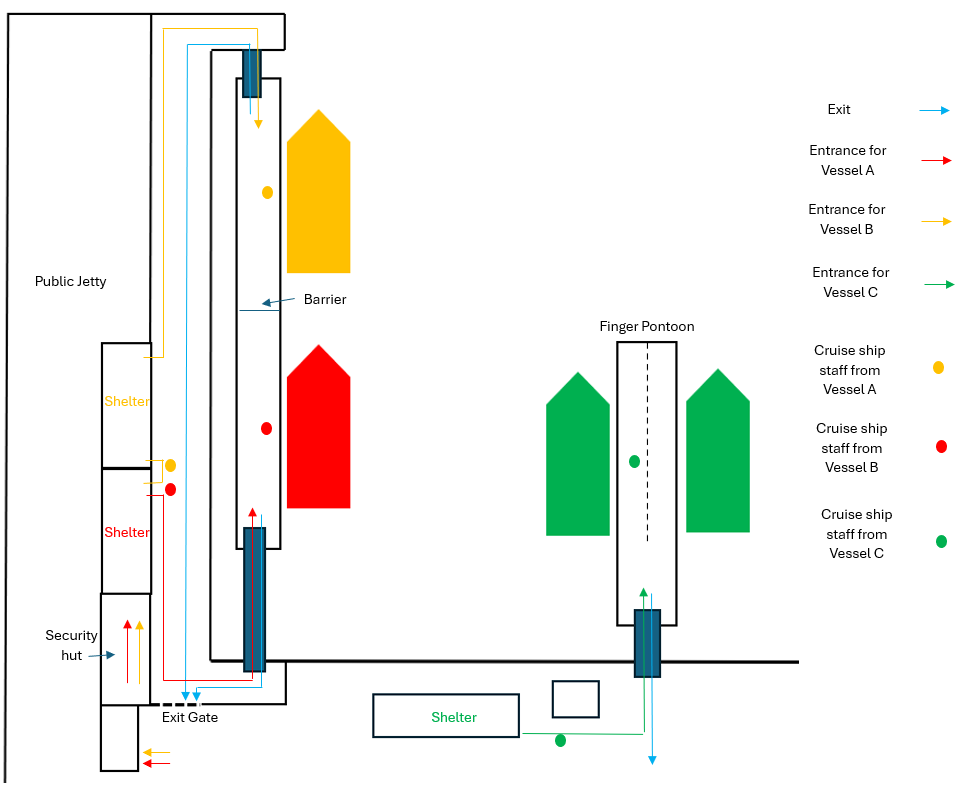
Additionally, the pontoon alongside the public jetty has also been refurbished and repurposed in accordance with ISPS code to allow tenders from two different ships to use this pontoon. In order to facilitate this, should it be necessary, the pontoon will be split half way along to give two distinct landing points, north and south with access to the public jetty via gangways north and south respectively. See also the note on extra staff below.
Two tenders are permitted alongside at any time on pontoons but embarkation/disembarkation will only be permitted from one tender at a time.
LNTM 08/2024 has been fully revised to cover all aspects of passenger vessel tender operations. The revised Local Notice to Mariners 08/2024 (falklands.gov.fk) can be found on the FIMA website.
Zodiac Operations
Cruise ships transferring passengers to the public jetty are advised that zodiacs left secured to the public jetty should not be left unattended at any time. Lifejackets may be left in the shelter adjacent to the pontoon where the zodiacs are operating from, however this is at their own risk. Operators are reminded that once they leave the Temporary Restricted Area set up by Falklands Security Services Ltd, they must enter through the correct security check point where ID cards will be checked.
Public Jetty Pontoon
Vessels are to manoeuvre with caution and at reduced speed when arriving and departing at the pontoons. Only one tender may arrive/depart at any one time. When vessels are alongside the public jetty pontoons/finger pontoons they must make their vessel fast by a minimum of one forward spring and one aft spring and their engines must be placed into neutral.
Safe Navigation in Stanley Harbour and Port William
All vessels operating within Falklands waters and their harbours must at all times apply the International Regulations for the Prevention of Collisions at Sea (COLREGS) with the observance of good seamanship. Stanley Harbour and Port William are particularly busy with harbour launches and fishing vessels during the months of January/February. Tender and Zodiac drivers are requested to give a wide berth to these vessels and pass by them at a safe distance and speed especially when passing by their bow or stern.
Ships Staff and the ISPS Code.
All ships Crew and Staff must be in possession of an in date and valid Ship Identity Card before disembarking and be prepared to show this to Port Security staff before entering the Temporary Restricted Area. Failure to comply will result in the person, without exception, being denied access to the vessel until their identity can be verified and the Port Facility Security Officer, or their representative, informed.
Extra staff to assist on the pontoons
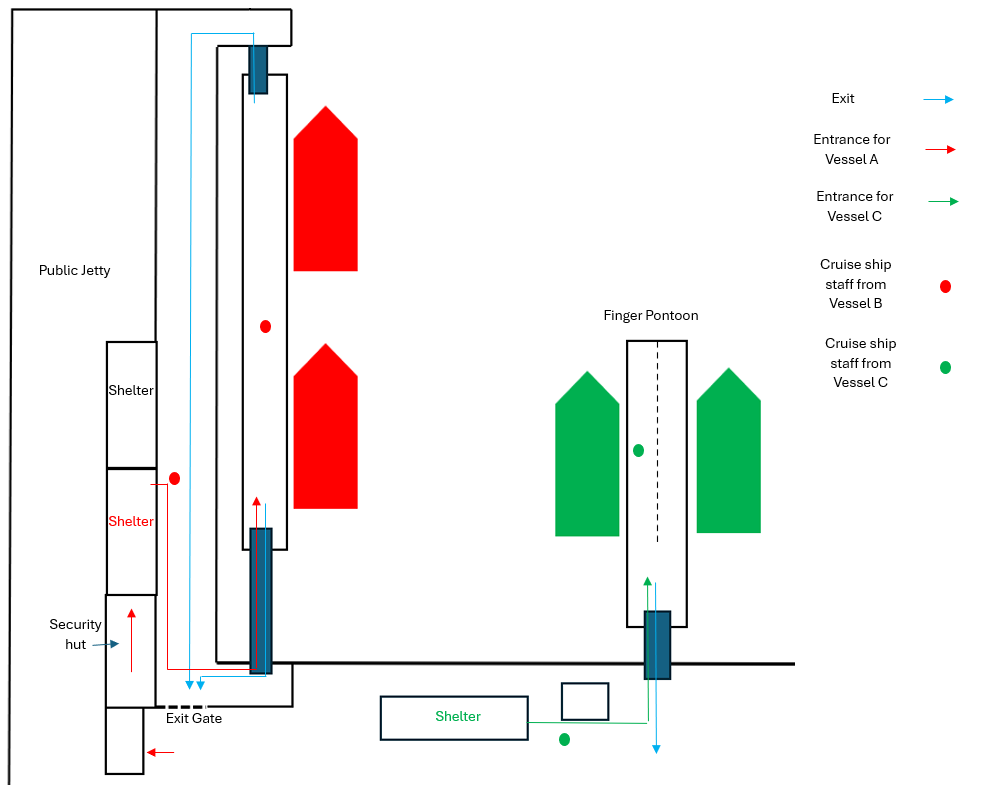
Each vessel tendering to the pontoons must ensure that at least one staff member from the ship is located on the pontoon to assist with passengers getting on and off the pontoons and at least one member of staff at the shelter to assist with passenger control on and off the pontoons. This responsibility lies with the cruise ship and not with the security staff. Cruise ships may place additional staff to assist with passengers but must provide the minimum staff mentioned above.
Appendix 1 shows the lay out of the public jetty when tenders (or zodiacs) are operating from three different cruise ships (Vessel A, B and C). This Appendix also shows the general flow of traffic to and from the pontoons and the location where the minimum requirement of staff should be placed.
Appendix 2 Shows the Public jetty being used by only Two cruise ship tenders/zodiacs.
For the purpose of safety, cruise ship staff operating on the pontoons should ensure that passengers are only allowed on the pontoons when their tender/zodiac is ready to receive them. When loading and disembarking passengers, they should keep them moving towards the exit gates and not remain standing around on the pontoons.
The Maritime Authority will be conducting spot checks to ensure compliance with all of the above.
Appendix 1
Appendix 2
Speed Restrictions
Any cruise ship tenders / zodiacs must adhere to the speed restrictions when operating in Stanley Harbour. These vessels are requested to keep their speed below 4kts within 200m of the South shore of Stanley Harbour and to also reduce their speed when passing other moored vessels. They should also proceed at a safe speed and navigate with extreme caution when passing other vessels at anchor within the harbour.
For more information, please contact
the Maritime Authority
You’ll find our office hours, location, and full contact details below.